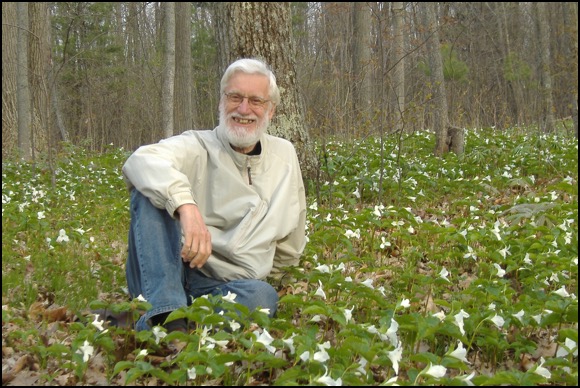
Photo courtesy of Margarita DelgadoBiography
I was born in southern Germany on March 8, 1936. With much enthusiasm, I studied botany, zoology, chemistry, philosophy and pedagogy at several universities in Germany, Austria, and Switzerland. After receiving my doctorate, with summa cum laude, in systematic botany from the University of Munich, I spent one year at the University of Alberta with Ludwig von Bertalanffy, one of the founders of General Systems Theory, and another year at the University of California with E. M. Gifford and L. Stebbins. Then, as assistant, associate, and full professor, I spent 33 years in the departments of botany and biology of McGill University in Montreal. In 1997 I retired as emeritus professor and moved to Kingston, Ontario.
At McGill University I taught courses in botany, general biology, the history and philosophy of biology, and biology in relation to the human predicament. I carried out research on the morphological development (organogenesis) of flowers, the development and evolution of flowering plants, continuum and process morphology, the power and limitations of science, and the philosophy of biology. My research led me from plant morphology to infinite issues (including Ken Wilber and Korzybski). In 1976 at Naropa Institute in Boulder, Colorado (that became Naropa University) I taught a summer course on Modern Biology and Zen.
My publications comprise nearly a hundred papers, book chapters and books. Although predominantly on topics of plant morphology, some of them deal with various aspects of biology, alternative holistic medicine, philosophy, and spirituality. My latest book is Science and Beyond: Toward Greater Sanity through Science, Philosophy, Art, and Spirituality (2021).
I lectured at many universities around the world, including Harvard University, and the Universities of California, Paris, Berlin, Zurich, Delhi, Malaya, and Singapore. I presented papers at many national and international conferences and symposia and also organized symposia at international congresses. To learn more about the relation of science and spirituality, I attended several symposia on science and consciousness. In 1995 I was invited to give a talk on the relation of science, especially life science, and spirituality at the 60th birthday celebrations of the Dalai Lama.
I received many honours and awards. In 1973 I became a fellow of the Linnean Society of London (F.L.S.), in 1982 I was elected a fellow of the Royal Society of Canada (F.R.S.C.), and in 1995 I received an honorary doctorate (D.Sc.) from the Open International University for Complementary Medicine at Colombo, Sri Lanka, for my contributions to holistic alternative medicine.
Since I retired in 1997, I research and write on broad and integral topics of science, philosophy, and spirituality (see Present Interests and Publications). I gave talks and workshops on various general topics such as the relation of science and spirituality, the importance of Yin-Yang, and alternative medicine. Furthermore, I facilitated various types of meditation such as dancing and laughing meditation, including laughter yoga.
I published My Life Lessons: What I have learned in my life and Integral Visions and Nonduality
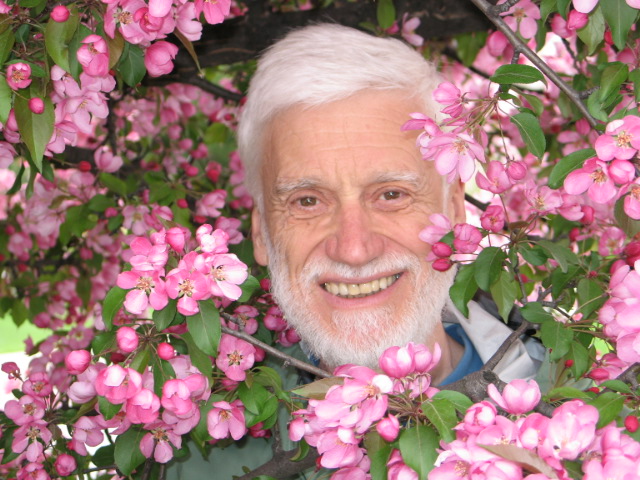
Photo courtesy of Shelley CohlFlowers and Mandalas
Flowers have fascinated me my whole life. As a child, I enjoyed picking flowers for my beloved mother. Later on, my doctoral thesis dealt with the development and evolution of flowers. At McGill University initially my research focussed on floral development. I developed a technique to display floral development in three dimensions. In 1973 I published with the help of students and technicians the award-winning Organogenesis of Flowers. A Photographic Text-Atlas. Although a scientific book, I underlined also the aesthetic value of the photos. Both science and art have always been important to me. In the 60s, during the era of flower power, I taught a course on flowers. Although predominantly scientific, this course also included sections on the importance of flowers in art and literature. I concluded the course with a polysensual multi-media show of flowers in science, art, literature, and everyday life.
As I have been exploring more deeply spiritual dimensions of life, mandalas have become increasingly important for me. Often they can be understood as symbolic representations of the Kosmos, including ourselves. Their center may be seen as the source of everything, the source from which the manifoldness of existence arises. One could also say that the source represents the unmanifest from which manifest reality arises. Being unmanifest, the source appears unnamable, beyond words, mysterious, in contrast to manifest reality that can be talked about. According to Daoism, specifically the first chapter of Laozi's (Lao-Tzu's) Daodejing (Tao Te Ching), heaven and earth, Yang and Yin, and everything that can be named originate from the unnamable. Ultimately, the namable and the unnamable are not two (one could say one). According to the Heart Sutra of Buddhism that has greatly inspired me, this wisdom has been expressed as: form is emptiness and emptiness is form (see, for example, Tenzin Gyatso, The Fourteenth Dalai Lama, 2005. Essence of the Heart Sutra. Boston: Wisdom Publications).
In Wilber's AQAL Map and Beyond I presented a dynamic mandala that can be transformed in so many ways that it could comprise all mandalas. Thus, this dynamic mandala could be seen as a mandala of mandalas, or the set of all mandalas. I have referred to a mandalic worldview, which characterizes also my free online book Wholeness, Fragmentation, and the Unnamable: Holism, Materialism, and Mysticism - A Mandala.
Flowers have been seen as mandalas because they have a mandalic form. In bisexual flowers the female organ(s), or, strictly speaking, the organ(s) that produce the female sex, occupy their centre. In this sense, the centre of flowers is not the unnamable, but part of form, the namable. However, if in a more metaphorical sense, the female, the feminine, is equated with the mysterious unnamable, then a flower can be seen as a mandala in the above sense. In the sixth chapter of the Daodejing (Tao Te Ching), the "mystic female" can be interpreted as emptiness, that is, the unnamable. In the mysterious Chinese text The Secret of the Golden Flower: The Chinese Book of Life, the golden flower is a symbol for light and the One (see the translation by Richard Wilhelm with a foreword and commentary by C. G. Jung, 1962. London: Routledge & Kegan Paul; and Osho.1999.The Secret of Secrets. Talks on The Secret of the Golden Flower. The Rebel Publishing House).
David J. Bookbinder created a wonderful gallery and blog on flower mandalas in which the source, the unnamble, is represented implicitly or explicitly. I am grateful to David Bookbinder for giving me permission to reproduce here one of his beautiful flower mandalas, Violet Morning Glory I, in which the source is represented explicitly as the empty centre.
It does not seem a meaningless coincidence that during my life I have been deeply attracted to flowers, mandalas, the feminine, and the mystery beyond words.
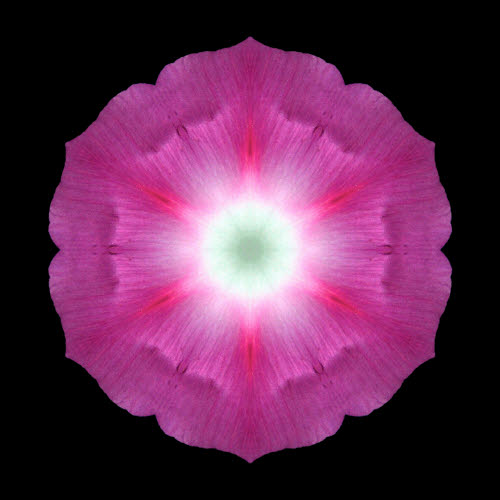
Morning Glory Mandala. Courtesy of David J. Bookbinder.
Both my scientific research and my existential experiences and insights have validated the profound wisdom of Yin-Yang. One of the key concepts of my research in plant morphology (the form of plants) has been the continuum (see, for example, my publications with Dr. Bernard Jeune and Professor Rolf Rutishauser). In the Yin-Yang symbol, this concept is emphasized through the continuity of Yin and Yang, one merging gradually with the other, which acknowledges a fuzziness that is very different from typical Western thinking in terms of mutually exclusive categories that oppose each other in an either/or fashion. Yin and Yang also cooperate in contrast to the Western Darwinian and capitalist emphasis on competition. Furthermore, they complement each other. My research, and especially joint publications with Dr. Rolf Rutishauser, have focused on the importance of complementarity in plant morphology, science, and society. Chapter 6 on Complementarity of Wilber's AQAL Map and Beyond also deals with this topic.
In addition to continuity, cooperation, and complementarity, Yin-Yang emphasizes dynamics. Yin and Yang change continuously: while one increases, the other decreases. Alan Watts wrote about Daoism as "The Watercourse Way". Buddhism also emphasizes impermanence as the hallmark of samsara, the relative world that scientists investigate. In my research on plant morphology, I developed a more dynamic approach that I called process morphology. This approach is based on or compatible with process philosophy and even calls for a verb-based process language (see my article Why do we need a more dynamic study of morphogenesis? Descriptive and comparative aspects. In: D. Barabé et R. Brunet (eds.) Morphogenèse et Dynamique. Orbis, Frelighsburg,1993).
Although Yin and Yang change continuously, they tend toward a balance. According to Chinese medicine, health is balance, a dynamic balance. I emphasize this view of health in my article on Non-conventional medicines and holism (see Publications), and in Healing Thinking and Being.
Many other aspects of Daoism have become very important to me in my personal life such as paradox, wordlessness, silence (Dao cannot be talked about), non-doing, spontaneity, playfulness, flexibility, softness, gentleness, humility, wholeness, oneness, no-thingness, emptiness, and suchness. Some of these are also typical of Buddhism, especially Zen Buddhism, and other spiritual traditions that have inspired me.
