Chapter 4
“Whatever you might say the object “is”, well it is not” (Korzybski)
"A great deal of our human problems, confusions, conflicts, and violence, at diverse levels - personal, interpersonal, societal, and international - can be attributed to our use of "is" in the identification and predication mode" (Milton Dawes)
Watch my interview on Korzybski's General Semantics for New Thinking Allowed
It has become fashionable to insist on many sorts of identity and identification. However, as Korzybski and others have emphasized, we cannot find an identity of word and object, map and territory. Thus, words and language can give us only a pale reflection of reality, which ultimately remains unnamable. Disregarding the non-identity of language and reality can lead to negative psycho-logical reactions, conflict, violence, and war. Thinking, speaking, and writing with an awareness of non-identity appears healing and healthy.
Language and Reality
As he grew older and wiser, Albert Einstein noted: “In my youth I thought Truth can be known. Now I think otherwise; now I think, Truth is unknowable and will always be unknowable” (Albert Einstein, quoted by Bhagwan Shree Rajneesh 1978, p. 100). Although many people, including scientists, might disagree, Einstein based his assertion on solid evidence: we know about limitations of our perception as a result of the organization of our brain, nervous system and sensory apparatus. Some species of animals can perceive aspects of reality beyond our direct experience. For example, bees can see beautiful ultraviolet patterns in flowers invisible to us; bats can generate and perceive sounds beyond our perception. But even if our perception were more truthful, the language, language structure and logic we use to formulate insights, restrict and distort that which is, namely Truth. In other words, “human experience gets filtered and mediated by contingent features of human sensory organs, the human nervous system, and human linguistic constructions” (Wikipedia page on General Semantics). Linguistic constructions comprise words and the language structure and logic that relate words to one another. “Words are probably one of the deepest and most unconscious filters we have” (Falconar 2000, p.VI). “Most of us human beings think that we are masters of words; the truth is they master us, we are enslaved by words” (ibid., p. 3). They master us in a way that tends to remove us more or less from reality because they fragment the wholeness of reality. Through words, “languages have taught us to separate things such as mind and body, time and space, outside and inside (ibid., p. 6). But “there is no such thing as an object in absolute isolation” (Korzybski 1958, p. 60/1/see all Korzybski 2010). Everything appears interconnected and integrated into an all-encompassing whole, ultimately the whole universe or Kosmos. Therefore, “to use words to sense reality is like going with a lamp to search for darkness” (Falconar, ibid., p.3). Nonetheless, words can be useful, especially if it understood that “words are not the things we are speaking about” (ibid., p. 60). Words refer to concepts that have been abstracted from the all-encompassing whole. Even the particular objects (fragments) they refer to, they cannot cover entirely. They cover only an aspect because “an object has many characteristics on different levels such as the macroscopic, microscopic and sub-microscopic. Most of these characteristics are unknown to us and so they are not included in the word we give it, the object’s name (ibid., p. 7). "Whatever you might say the object “is”, well it is not"(Korzybski, ibid. p. 35). Hence, we cannot insist on an identity of the word and the object it refers to. The word (concept) represents only a selection of some of the characteristics of the object.
Let me illustrate this with some examples. The word that refers to the concept “apple” has been defined by some characteristics of apples such as their development, shape, anatomy, etc. It leaves out many characteristics of apples such as their beauty, brilliance, and interconnectedness with the all-encompassing whole. Thus, Magritte painted an apple and below the image he wrote: “Ceci n’est pas une pomme” (This is not an apple). This may appear puzzling or nonsensical to many people, but a painting of an apple "is" not an apple, only an image of an apple; and an image of an apple "is" not the same as an apple, it lacks identity with the apple because an image of an apple cannot include all of the characteristics of an apple. Like a word, it cannot cover the whole object. Therefore, "whatever you might say the object "is", well it is not"(Korzybski, ibid., p. 35).
Another example: “John is a criminal”. Again, John "is" much more than what the definition of criminal entails. He has also positive emotions more or less similar to those of other human beings.
Words refer not only to single objects but also to categories of objects such as “apple” or “human being”. We have to stress that every member of the category, such as every human being, has unique characteristics. What holds members of a category together are only the characteristic(s) that define the category. Very often we cannot find characteristics that apply to all members of the category (see, e.g., Sattler 1986, pp. 82-85). For this reason one cannot generalize or generalizations have limitations. Much harm has been done by inappropriate generalizations.
The Unnamable
Regardless of wether a word refers to an object, or a category of objects, or a category of categories, “reality is far from words and it is very different from what a naïve person thinks it is” (Falconar, ibid., p. 7). Therefore, to come closer to reality, we have to become silent. Instead of using words immediately as we encounter a new situation, it would be helpful to pause and first experience the situation non-verbally. Subsequently, we could use words, while recognizing that “there is always more than can be said about anything” (which Korzybski explained through the Structural Differential). “Whatever we may say will not be the objective level, which remains fundamentally un-speakable…The objective level is not words…neither can it be understood as ‘non-expressible by words’ or ’not to be described by words’, because the terms ‘expressible’ or ‘described’ already presuppose words and symbols (Korzybski, ibid., p. 34). Thus, the recognition of the non-identity of word and object, language and reality, leads to the recognition of the primordial importance of silence that has been emphasized in many contemplative traditions of the East and West. It leads to the recognition of the Unnamable that can be experienced in meditation (see also my essay Beyond Thinking, Writing, and Speaking - The Unnamable).
Korzybski’s Structural Differential
Although the Unnamable is of primordial importance, words and language remain, of course, important for communication. And although words and language appear far from reality, they have some connection with reality because they have been abstracted from reality, which means that they contain some selected features of reality. Korzybski devised the Structural Differential to indicate the relation between the word and the object, between the object and reality, and between different levels of abstraction.
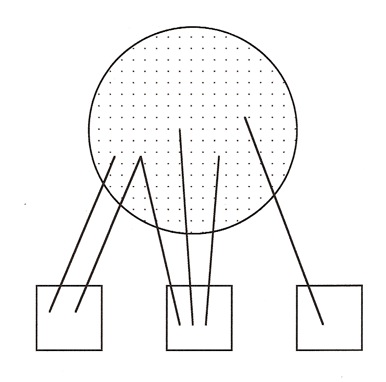
Figure 4-1. Explanation in text.
Figure 4-1 illustrates the relation between three words and the object they refer to (Different levels of abstraction and the relation of the object to reality have not been included). The large upper circle represents the object, and the very large number of dots within it represents the characteristics of this object. The three small squares represent three words (concepts) that refer to the object. As indicated by the lines, the words (concepts) are defined by a relatively small number of the characteristics of the object. Therefore, we cannot claim an identity of the words and the object. Put differently, the words do not cover the whole object: they have been abstracted from the object, which means that they have been defined only by a selection of some of the characteristics of the object. (Note that the many characteristics of the object (represented by dots) have also been abstracted from the integrated whole of the object as different objects have been abstracted from the all-encompassing whole of reality). For a full presentation of Korzybski's Structural Differential see Stockdale.
Note that different characteristics of the object can be selected to define a word (concept). For example, from the object called John we can select the characteristics that make him a criminal, or we can select the characteristics that make him a lover, or we can select the characteristics that make him a sad person, etc. Each abstraction refers to one aspect of John, but none captures John entirely.
The squares in Figure 4-1 could also represent maps, in which case the large circle represents the territory of these maps. Obviously, “a map is not the territory it represents, but, if correct, it has a similar structure to the territory, which accounts for its usefulness (Korzybski, ibid. p. 58). As with words (concepts), we can have different maps that refer to the same territory. For example, one can have morphological, geological, economic, ethnological, and many other maps that refer to a country like Canada. None of these maps “is” Canada, all of them function as abstractions from Canada based on different selections of characteristics.
Ken Wilber devised a hierarchical (holarchical) map of the Kosmos (called AQAL map). He based this map on a selection of traits that support a hierarchical (holarchical) interpretation of reality. However, as I have shown in in various publications one can also select characteristics that support non-hierarchical interpretations (see, for example, my essay on Ken Wilber's AQAL Dogma). If one can see that different interpretations reflect different selections of traits, different abstractions, they can be seen as complementing each other. However, if we confuse abstractions with reality, then conflict arises and this conflict can be more or less harmful depending on the situation.
Harmful Thinking and Healing Thinking
Harmful thinking confuses abstractions with the objects or reality from which they have been abstracted. In contrast, healthy and healing thinking is based on an awareness of abstraction, an awareness of the non-identity of map and territory, word and object, word and reality.
Most, if not all conflicts and wars appear to be based on or related to a lack of awareness of abstraction. If we think that the other person or nation “is” evil, and if we want to eradicate evil, we feel that we have to fight or kill. If, however, we recognize that that person or nation is evil and good and infinitely more than we can express in words, then we can become silent and connect also to the goodness. Jampolski (1979, (pp. 124-125) recounts how one night he was called to see a patient on the locked psychiatric ward. As he could see through the small window in the door of the patient’s room, the patient had become very violent and aggressive. Jampolsky felt scared and afraid to enter into the patient’s room. However, as he continued to look through the window, it occurred to him that in spite of his forceful and aggressive behaviour, the patient also seemed scared. Admitting to each other that they felt scared created a bond and as a result Jampolsky could walk into his room, talk to him and give him medicine without getting hurt. If he had seen in him only the obvious aggressiveness, if he would have simply labeled him as an aggressive patient, he could not have treated him peacefully. Kierkegaard wrote: “Once you label me, you negate me”.
One may be theoretically aware of abstraction and yet forget it in practical situations. To help us remember, Korzybski devised the Structural Differential and extensional semantic devices. One of these devices involves adding “etc” in conjunction with “is”. For example, instead of saying, “Jampolki’s patient is aggressive”, one would say, “he is aggressive, etc”, which includes his other traits and indicates that his aggressiveness is an abstraction. Furthermore, instead of referring simply to Jampolski’s patient, one would refer to Jampolski’s patient-October 22, 2009-universe, which indicates the context and his connection with the universe. Hyphens are used to emphasize interconnectedness such as, for example, the organisms-as-a-whole-in-the-environment. Quotation marks are used to indicate the highly abstract nature of a word such as, for example, “love”. Korzybski pointed out how the use of the extensional devices can be healing and thus lead to greater sanity (see also my essay on Healthy Language-Behaviour and Spirituality).
One might find these extensional devices contrived or awkward. Of course, one does not need them, if one remains always aware of abstraction. But who, except perhaps some rare individuals, can claim to retain always an awareness of abstraction.
Instead of using the extensional device "etc." that still includes "is" such as "He is sick, etc.", one could use constructions that do not include "is" (see Kodish and Kodish 2011 and Kellogg 1987)). For example, instead of saying "He is a politician," which includes what has been called the "is of identity," one could say "He works as a politician." And instead of saying "The rose is red," which includes what has been called the "is of predication," one could say "The rose looks red (to me)." Since the "is of predication" also involves an identification, it could be subsumed under the "is of identity" in the widest sense.
We have been deeply conditioned by a language structure that implies the law of identity, and therefore identity and identification remain a major issue for many people, groups, nations, etc. And “every identification is bound to be in some degree a misevaluation (Korzybski, ibid., p. XXXIV) that may lead to conflict and possibly even war (see also Kodish and Holsten 1998).
It happens again and again that “we read unconsciously into the world the structure of the language we use” (Korzybski, ibid., p. 60). But even if we become aware of the importance of language structure, we may not fully realize to what extent it affects our psyche. Korzybski emphasized that “psychological” can mean “psycho-logical”, which underlines the importance of logic and language structure for our psyche. He also referred to semantic reactions. If we use the “is” of identity and predication, semantic reactions may be negative and may lead to insanity. For example, if we say this person or this nation is evil, such a statement may lead to paranoia and insanity.
Identification and a lack of awareness of abstraction can also lead to “a tendency to make static, definite, and, in a way, absolutistic one-valued statements. But when we fight absolutism, we quite often establish, instead, some other dogma equally silly and harmful. For instance, an active atheist is psycho-logically as unsound as a rabid theist" (Korzybski, ibid., p. 140). When we forget the characteristics left out in the abstraction, we tend to think that we are right and that our statement is the only possible one.
Conclusions
1. Truth (that which is) cannot be expressed through words.
2. Words fragment the wholeness of reality. No object referred to by a word exists in isolation.
3. Words are not identical with the objects they refer to. Maps are not identical with the territory they refer to. Hence, whatever we say the object or the territory is, it is not. There is always more than can be said about anything.
4. To come closer to reality, we have to become silent. Words and language cannot capture reality. Therefore, it seems advisable to refrain from verbalizing immediately when we encounter a new situation. First pause, see, sense, intuit, visualize, and only then verbalize, if it seems necessary or desirable.
5. To illustrate why words cannot capture an object and reality, Korzybski devised the Structural Differential, which makes evident that words are much less than the object or reality they refer to.
6. Words (concepts) constitute abstractions from the object or reality, which means that they are defined by only relatively few of the large number of characteristics of the object. What we call the characteristics of the object are also abstracted from the wholeness of the object, and objects are abstracted from reality.
7. From the same object or territory different abstractions can be made through a different selection of characteristics. If this process of abstraction is understood, different abstractions can be seen as complementing one another (instead of being antagonistic).
8. Healthy and healing thinking recognizes the process of abstraction, whereas harmful thinking implies an often subconscious belief in the identity of map and territory, word and object, or word and reality.
9. Extensional devices, suggested by Korzybski, aid in a healthier use of language. Alternatively, avoiding the "is" of identity and predication can lead to a saner world.
10. Language structure and logic affect our psyche: they are psycho-logical. Lack of awareness of the process of abstraction can lead to insanity, conflict and war.
11. If children and adults were taught the process of abstraction and the use of extensional devices, we would live in a saner world.
References
Dawes, M. 2010. Clearer thinking through practicing E-Prime. Etc: A Review of General Semantics 67 (4): 447-451.
Falconar, T. 2000. Creative Intelligence and Self-Liberation. Korzybski, Non-Aristotelian Thinking and Eastern Realization. Crown House Publishing.
Jampolsky, G.G. 1979. Love is Letting Go of Fear. Millbrae, CA: Celestial Arts.
Kellog, E. W. III 1987. Speaking in E-Prime: An experimental method for integrating general semantics into daily life. Etc.: A Review of General Semantics 44 (2): 118-128.
Kodish, B.I.: Korzybski Files (blog) http://korzybskifiles.blogspot.com/2013/06/aristotles-non-aristotelianism.html
Kodish, S.P. & B.I. 2011. Drive Yourself Sane. 3rd edition. Extensional Publishing.
Kodish, S.P. and Holsten, R. P. (eds.). 1998. Developing Sanity in Human Affairs. Praeger.
Korzybski, A. 1958. Science and Sanity. The International Non-Aristotelian Library Publishing Company. CD-ROM edition 1996 http://esgs.free.fr/uk/art/sands.htm
Korzybski, A. 2010. Selections from Science and Sanity by Alfred Korzybski, 2nd edition. The New Non-Aristotelian Library.
Rajneesh, Bhagwan Shree. 1978. The Way of Tao. Delhi: Motilal Banarsidass.
Sattler, R. 1986. Biophilosophy. Analytic and Holistic Perspectives. Heidelberg/New York: Springer.
Stockdale, S. The Structural Differential - ThisIsNotThat https://www.thisisnotthat.com/structural-differential/
For more quotes from Korzybski’s Science and Sanity and Falconar’s Creative Intelligence and Self-Liberation. Korzybski, Non-Aristotelian Thinking and Eastern Realization, see Korzybski Quotes.
Continue with Chapter 5 on Language Transcending Logic, or return to Table of Contents of this book ms on Healing Thinking and Being.
Latest update on February 10, 2020.
Home
